
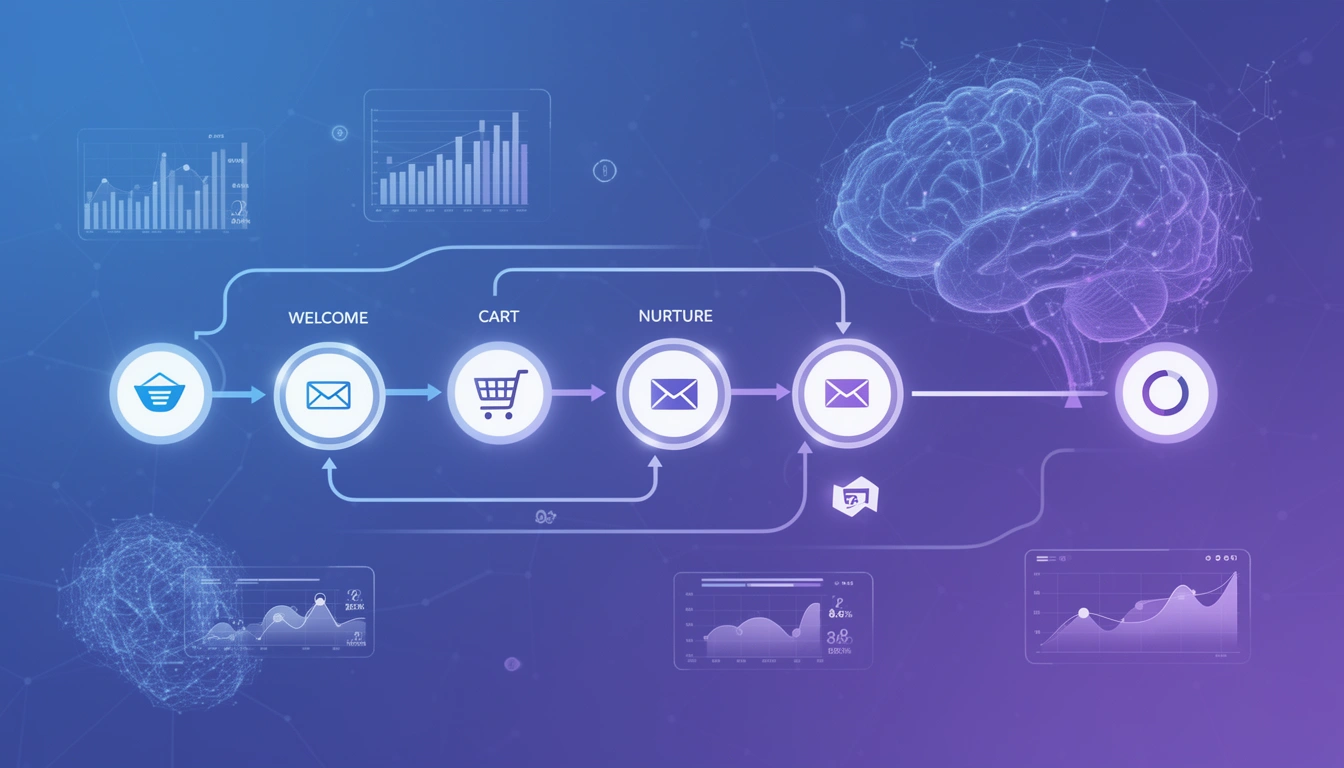
Email automation has evolved from a luxury feature to an absolute necessity for businesses in 2026. With AI-powered platforms making sophisticated workflows accessible to everyone, there's no excuse for manually sending repetitive emails. Whether you're welcoming new subscribers, nurturing leads, or re-engaging dormant customers, automation ensures your message reaches the right person at the perfect moment without lifting a finger.
In this comprehensive guide, we'll explore how to build high-converting email automation workflows that save time, increase revenue, and deliver exceptional customer experiences.
What Are Email Automation Workflows?
Email automation workflows are pre-designed sequences of emails triggered by specific actions, behaviors, or time intervals. Instead of manually sending individual emails, you create a set of rules that automatically deliver personalized messages based on subscriber activity.
Think of workflows as your 24/7 marketing assistant constantly monitoring customer behavior and responding with the perfect message at the optimal time.
Key Components of Effective Workflows
- Triggers: The action or event that starts the workflow (signup, purchase, cart abandonment)
- Conditions: Rules that determine which path a subscriber takes (opened email, clicked link, made purchase)
- Actions: What happens next (send email, wait period, update contact properties)
- Goals: The desired outcome you're optimizing for (conversion, engagement, retention)
10 Essential Email Automation Workflows for 2026
1. Welcome Series Workflow
Your welcome series is the foundation of subscriber relationships. First impressions matter, and this workflow ensures new subscribers immediately understand your value proposition.
Workflow Structure:
- Email 1 (Immediate): Welcome message with brand introduction and incentive
- Email 2 (Day 2): Value demonstration with customer success stories
- Email 3 (Day 4): Educational content about your product/service
- Email 4 (Day 7): Special offer or call-to-action
Pro Tip: Use AI-powered personalization to customize welcome emails based on signup source or initial preferences.
2. Abandoned Cart Recovery
Cart abandonment rates hover around 70% in 2026, representing massive revenue opportunity. A well-timed reminder can recover 15-30% of abandoned carts.
Workflow Structure:
- Email 1 (1 hour): Gentle reminder with cart contents
- Email 2 (24 hours): Social proof and urgency elements
- Email 3 (48 hours): Discount offer or free shipping incentive
Performance Metrics: Track recovery rate, revenue per email, and optimal send times. A/B test discount amounts to find your sweet spot.
3. Post-Purchase Nurture
The sale isn't the end it's the beginning. Post-purchase workflows build loyalty, encourage reviews, and drive repeat purchases.
Workflow Structure:
- Email 1 (Immediate): Order confirmation with tracking
- Email 2 (Delivery day): Product tips and usage guides
- Email 3 (Day 7): Review request
- Email 4 (Day 14): Cross-sell complementary products
- Email 5 (Day 30): Loyalty program invitation or replenishment reminder
4. Lead Nurturing Workflow
Not every lead is ready to buy immediately. Lead nurturing workflows educate prospects over time, building trust and demonstrating expertise.
Workflow Structure:
- Email 1: Educational content addressing primary pain point
- Email 2 (3 days): Case study or success story
- Email 3 (5 days): Product demonstration or free tool
- Email 4 (7 days): Comparison guide or ROI calculator
- Email 5 (10 days): Special offer with urgency
Segmentation Strategy: Branch your workflow based on engagement. High-intent leads (multiple opens, link clicks) should receive sales-focused content faster.
5. Re-engagement Campaign
Inactive subscribers hurt your deliverability rates. Re-engagement workflows win back dormant contacts or cleanly remove them from your list.
Workflow Structure:
- Email 1: "We miss you" message with survey about preferences
- Email 2 (7 days): Showcase what they've missed (new products, content)
- Email 3 (14 days): Exclusive "comeback" offer
- Email 4 (21 days): Final chance to stay subscribed
Best Practice: If subscribers don't engage after 4 emails, automatically suppress them to maintain list health and improve email deliverability.
6. Birthday/Anniversary Campaign
Personal milestones create perfect opportunities for engagement. Birthday emails generate 342% higher revenue per email than promotional emails.
Workflow Structure:
- Trigger: 7 days before birthday/anniversary
- Email 1: Birthday greeting with special offer (valid for 2 weeks)
- Email 2 (On birthday): Reminder of offer availability
- Email 3 (3 days before expiry): Final reminder
7. Webinar/Event Workflow
Event promotion requires precise timing and multiple touchpoints to maximize attendance.
Workflow Structure:
- Email 1 (Registration): Confirmation with calendar invite
- Email 2 (1 week before): Reminder with speaker bios and agenda
- Email 3 (1 day before): Final reminder with join link
- Email 4 (1 hour before): "Starting soon" notification
- Email 5 (No-shows): Recording and next steps
- Email 6 (Attendees): Thank you with resources and CTA
8. Product Education Series
For SaaS and complex products, education workflows reduce churn and increase feature adoption.
Workflow Structure:
- Email 1 (Day 0): Getting started guide
- Email 2 (Day 3): Core feature tutorial
- Email 3 (Day 7): Advanced tips and tricks
- Email 4 (Day 14): Integration opportunities
- Email 5 (Day 21): Success checklist and upgrade path
Behavioral Triggers: If users complete specific actions, skip related emails to avoid redundancy.
9. VIP Customer Workflow
Your top 20% of customers generate 80% of revenue. Give them special treatment with dedicated workflows.
Workflow Structure:
- Trigger: Customer reaches VIP threshold (purchase amount, frequency)
- Email 1: VIP status announcement with exclusive benefits
- Email 2 (Monthly): Early access to new products
- Email 3 (Quarterly): Personalized product recommendations
- Email 4 (Special occasions): Double points or extra perks
10. Feedback Loop Workflow
Continuous improvement requires customer feedback. Automated surveys gather insights at optimal moments.
Workflow Structure:
- Email 1 (After key interaction): NPS or satisfaction survey
- Email 2a (Promoters): Request for review/referral
- Email 2b (Detractors): Customer service outreach
- Email 2c (Passives): Education or feature awareness
Building Workflows That Convert: Best Practices
Start Simple, Then Optimize
Don't try to build complex, multi-branch workflows immediately. Start with a basic 3-4 email sequence, monitor performance, then add sophistication based on data.
Progressive Enhancement Approach:
- Launch basic triggered sequence
- Add time delays based on engagement data
- Implement conditional branching for different segments
- Introduce behavioral triggers and dynamic content
- Test AI-powered send-time optimization
Personalization Beyond First Name
In 2026, using just a first name isn't personalization it's table stakes. True personalization leverages:
- Behavioral data: Browse history, past purchases, engagement patterns
- Demographic information: Location, company size, industry
- Lifecycle stage: New subscriber vs. loyal customer
- Engagement level: Active, occasional, or dormant
- Preferences: Content topics, product categories, communication frequency
With AI-powered email generation, you can create hyper-personalized content at scale without manual effort.
Optimal Timing and Frequency
The gap between emails can make or break your workflow effectiveness. Too frequent feels spammy; too sparse loses momentum.
General Timing Guidelines:
- Welcome series: 2-3 day intervals
- Abandoned cart: 1 hour, 24 hours, 48 hours
- Post-purchase: Immediate, delivery day, 7 days, 14 days, 30 days
- Lead nurturing: 3-5 day intervals
- Re-engagement: 7-14 day intervals
Pro Tip: Test different timing intervals for your specific audience. B2B and B2C audiences often respond to different cadences.
Mobile-First Design
Over 65% of emails are now opened on mobile devices. Every workflow email must be optimized for small screens:
- Single-column layouts
- Large, tappable CTAs (minimum 44x44 pixels)
- Concise subject lines (40 characters or less)
- Scannable content with clear hierarchy
- Fast-loading images with alt text
Testing and Optimization
Set up A/B tests within your workflows to continuously improve performance:
- Subject lines: Test question vs. statement, emoji vs. plain text
- Send times: Morning vs. afternoon vs. evening
- Email length: Short vs. detailed
- CTA placement: Top vs. bottom vs. multiple
- Personalization level: Generic vs. highly personalized
- Incentive offers: Discount percentage, free shipping, or gift
Testing Framework: Test one variable at a time, ensure statistical significance (at least 1,000 recipients per variant), and run tests for full workflow cycles.
Advanced Workflow Strategies for 2026
AI-Powered Predictive Sending
Modern platforms use machine learning to predict the optimal send time for each individual subscriber based on their historical engagement patterns. Instead of sending at a fixed time, AI determines when each person is most likely to open and click.
Implementation: Enable send-time optimization in your workflow settings. The AI analyzes open times over 2-4 weeks before optimizing delivery.
Dynamic Content Blocks
Rather than creating separate emails for different segments, use dynamic content that changes based on subscriber attributes:
- Product recommendations based on browse history
- Location-specific offers or event invitations
- Industry-relevant case studies for B2B
- Weather-triggered product suggestions
Cross-Channel Workflow Integration
Email doesn't exist in isolation. Integrate your email workflows with other channels:
- SMS: Send urgent reminders via text for high-priority actions
- Push notifications: Complement email with app notifications
- Retargeting ads: Display ads to subscribers who don't open emails
- Direct mail: Send physical mail to high-value prospects who don't engage digitally
Behavioral Scoring and Automation
Implement lead scoring within workflows to automatically route subscribers based on engagement:
- Email open: +5 points
- Link click: +10 points
- Product page visit: +15 points
- Cart addition: +25 points
- Purchase: +50 points
When subscribers reach certain score thresholds, trigger different workflow branches or alert sales teams for personal outreach.
Technical Setup and Requirements
Choosing the Right Platform
Not all email platforms offer robust automation capabilities. Look for:
- Visual workflow builder: Drag-and-drop interface for creating complex sequences
- Conditional logic: IF/THEN statements for branching paths
- Behavioral triggers: Actions based on clicks, opens, purchases
- Integration capabilities: Connect with your CRM, ecommerce platform, analytics
- Testing features: A/B testing within workflows
- Scalability: Handle growing contact lists without performance degradation
Platforms like Bokimo AI offer enterprise-grade automation features at a fraction of traditional costs, making sophisticated workflows accessible to businesses of all sizes.
Data Collection and Tracking
Workflows require clean, accurate data to function properly. Implement:
- Progressive profiling: Gradually collect information over multiple interactions
- Event tracking: Monitor website behavior, purchases, support interactions
- UTM parameters: Track campaign sources and effectiveness
- Custom fields: Store unique attributes relevant to your business
GDPR and Privacy Compliance
Automated emails must comply with data protection regulations:
- Include clear unsubscribe links in every email
- Honor opt-out requests immediately (within automated workflows)
- Obtain explicit consent before adding to workflows
- Provide preference centers for communication frequency
- Document data usage in privacy policies
- Implement data retention policies for inactive contacts
Common Workflow Mistakes to Avoid
1. Set It and Forget It Mentality
Workflows aren't perpetual motion machines. Markets change, products evolve, and customer preferences shift. Review and update workflows quarterly at minimum.
Maintenance Checklist:
- Check for outdated products or pricing
- Update seasonal references
- Remove links to deprecated pages
- Refresh creative elements and copy
- Analyze performance metrics and optimize
2. Over-Automation
Just because you can automate something doesn't mean you should. Some communications benefit from human touch:
- Responses to negative feedback
- High-value enterprise sales conversations
- Complex customer service issues
- Relationship-building with VIP clients
3. Ignoring Workflow Conflicts
When multiple workflows can trigger simultaneously, subscribers may receive confusing or contradictory messages. Implement priority rules:
- Transactional emails > Marketing emails
- Purchase confirmation > Abandoned cart
- Customer service > Promotional campaigns
4. Poor Segmentation
Sending everyone the same workflow ignores the diversity of your audience. Segment based on:
- Purchase history and value
- Engagement level
- Geographic location
- Company size or industry (B2B)
- Lifecycle stage
5. Neglecting Mobile Experience
Preview every workflow email on multiple devices before activation. What looks perfect on desktop might be unreadable on mobile.
Measuring Workflow Success
Key Performance Indicators
Track these metrics for each workflow:
- Workflow conversion rate: Percentage achieving the goal (purchase, signup, etc.)
- Revenue per subscriber: Total revenue divided by workflow entries
- Email-specific metrics: Open rate, click rate, unsubscribe rate for each email
- Time to conversion: How long from workflow start to goal completion
- Drop-off points: Where subscribers disengage or unsubscribe
Benchmarking Performance
2026 Workflow Benchmarks by Type:
- Welcome series: 50-60% open rate, 15-20% click rate, 5-8% conversion
- Abandoned cart: 40-50% open rate, 20-30% recovery rate
- Post-purchase: 60-70% open rate, 25-35% repeat purchase rate
- Re-engagement: 20-30% reactivation rate
- Lead nurturing: 35-45% open rate, 8-12% conversion rate
Continuous Improvement Process
- Monitor: Review workflow analytics weekly
- Identify: Find underperforming emails or drop-off points
- Hypothesize: Develop theories about why performance lags
- Test: A/B test solutions to your hypothesis
- Implement: Roll out winning variations
- Repeat: Continuously iterate for improvement
Real-World Workflow Examples
E-commerce: Complete Customer Journey
Scenario: Online apparel retailer wants to maximize customer lifetime value.
Integrated Workflow Strategy:
- Browse abandonment: Visitor views products but doesn't add to cart → Send product reminder with social proof
- Cart abandonment: Items added but no purchase → 3-email recovery sequence with progressive incentives
- First purchase: Welcome to family + style guide + review request sequence
- Repeat purchase: Loyalty program invitation + VIP benefits
- Seasonal: New collection previews timed to subscriber's preferred category
- Re-engagement: 90-day inactive → Win-back series with survey and offer
Results: 35% increase in customer lifetime value, 25% improvement in repeat purchase rate.
SaaS: Trial Conversion Optimization
Scenario: Project management software wants to convert more trial users to paid plans.
Workflow Strategy:
- Day 0: Welcome email with quick-start guide and onboarding video
- Day 1: If no project created → Tutorial on creating first project
- Day 1: If project created → Advanced features showcase
- Day 3: Team collaboration features + invite teammates CTA
- Day 7: Success story from similar company
- Day 10: ROI calculator and upgrade benefits
- Day 12: Limited-time upgrade discount (20% off)
- Day 14: Trial expiring reminder with special offer extension
- Day 15: Trial expired → Downgrade to free plan with upgrade prompts
Results: 42% trial-to-paid conversion rate (up from 28%).
B2B Services: Lead Qualification
Scenario: Marketing agency wants to identify sales-ready leads from content downloads.
Workflow Strategy:
- Day 0: Deliver downloaded content + related resource
- Day 2: Educational blog post on related topic
- Day 5: Case study from similar industry
- Day 8: Webinar invitation on advanced strategies
- Day 12: Free consultation offer
- High engagement path: Opened 3+ emails + clicked 2+ links → Alert sales team for outreach
- Low engagement path: Opened <2 emails → Move to quarterly newsletter list
Results: 3x increase in qualified leads passed to sales, 18% close rate on nurtured leads.
The Future of Email Automation
AI-Generated Content at Scale
Advanced AI is transforming workflow creation. Instead of writing each email manually, marketers provide goals and brand guidelines, and AI generates entire sequences optimized for conversion.
What's Possible in 2026:
- AI analyzes top-performing emails and replicates successful patterns
- Natural language processing creates personalized content for each subscriber
- Machine learning predicts optimal email length, tone, and CTA for segments
- Automated image generation creates unique visuals for each recipient
Hyper-Personalization at Individual Level
Moving beyond segment-based personalization, next-generation workflows create unique experiences for each subscriber using real-time data synthesis.
Predictive Analytics
AI predicts which subscribers are likely to:
- Churn (and triggers retention workflows)
- Upgrade (and sends conversion-focused content)
- Become brand advocates (and requests referrals)
- Need customer support (and offers proactive help)
Getting Started with Email Automation
Your 30-Day Implementation Plan
Week 1: Foundation
- Audit current email practices and identify automation opportunities
- Choose automation platform that meets your needs and budget
- Clean and segment email list
- Define goals for your first 3 workflows
Week 2: Creation
- Map out workflow logic and email sequences
- Write email copy or use AI generation tools
- Design templates (or customize pre-built ones)
- Set up tracking and analytics
Week 3: Testing
- Send test emails to internal team
- Check workflow logic and timing
- Verify mobile responsiveness
- Test unsubscribe and preference center functionality
Week 4: Launch and Monitor
- Activate workflows for small segment first
- Monitor performance daily for first week
- Gather feedback and make quick adjustments
- Scale to full list once performance is validated
Quick Win: Start with One Workflow
Don't try to automate everything at once. Choose the workflow with highest ROI potential for your business:
- E-commerce: Abandoned cart recovery
- SaaS: Trial user onboarding
- B2B: Lead nurturing
- Media/Publishing: Welcome series
- Services: Post-consultation follow-up
Perfect that one workflow, measure results, then expand to additional automation opportunities.
Conclusion
Email automation workflows are no longer optional they're essential for competitive email marketing in 2026. The businesses winning in their markets have moved beyond basic batch-and-blast campaigns to sophisticated, behavior-triggered sequences that deliver the right message to the right person at the perfect moment.
The beauty of automation is that it compounds over time. A workflow you build today continues generating results month after month, year after year, with minimal ongoing effort. It's the closest thing to perpetual motion in marketing.
Whether you're just starting with a simple welcome series or building complex, multi-branch nurture sequences, the key is to start now. Every day without automation is revenue left on the table and customer relationships left to chance.
With platforms like Bokimo AI offering enterprise automation features at startup prices, there's never been a better time to transform your email marketing from manual task to automated revenue engine.
Start with one workflow this week. Test, optimize, and expand. Your future self (and your bottom line) will thank you.