

Transactional Email Platform: Complete 2026 Guide for Businesses
A transactional email platform sends automated messages triggered by user actions password resets, purchase confirmations, shipping notifications. The whole point is making sure these messages actually arrive. They maintain uptime above 99% because "the email didn't send" is a support ticket nobody wants to answer.
Marketing emails go to lists. Transactional emails go to individuals who just did something. That's why open rates hit 80-85% for transactional versus 20-25% for marketing people are waiting for these messages. Getting this right matters for trust and revenue.
How transactional platforms differ from marketing tools
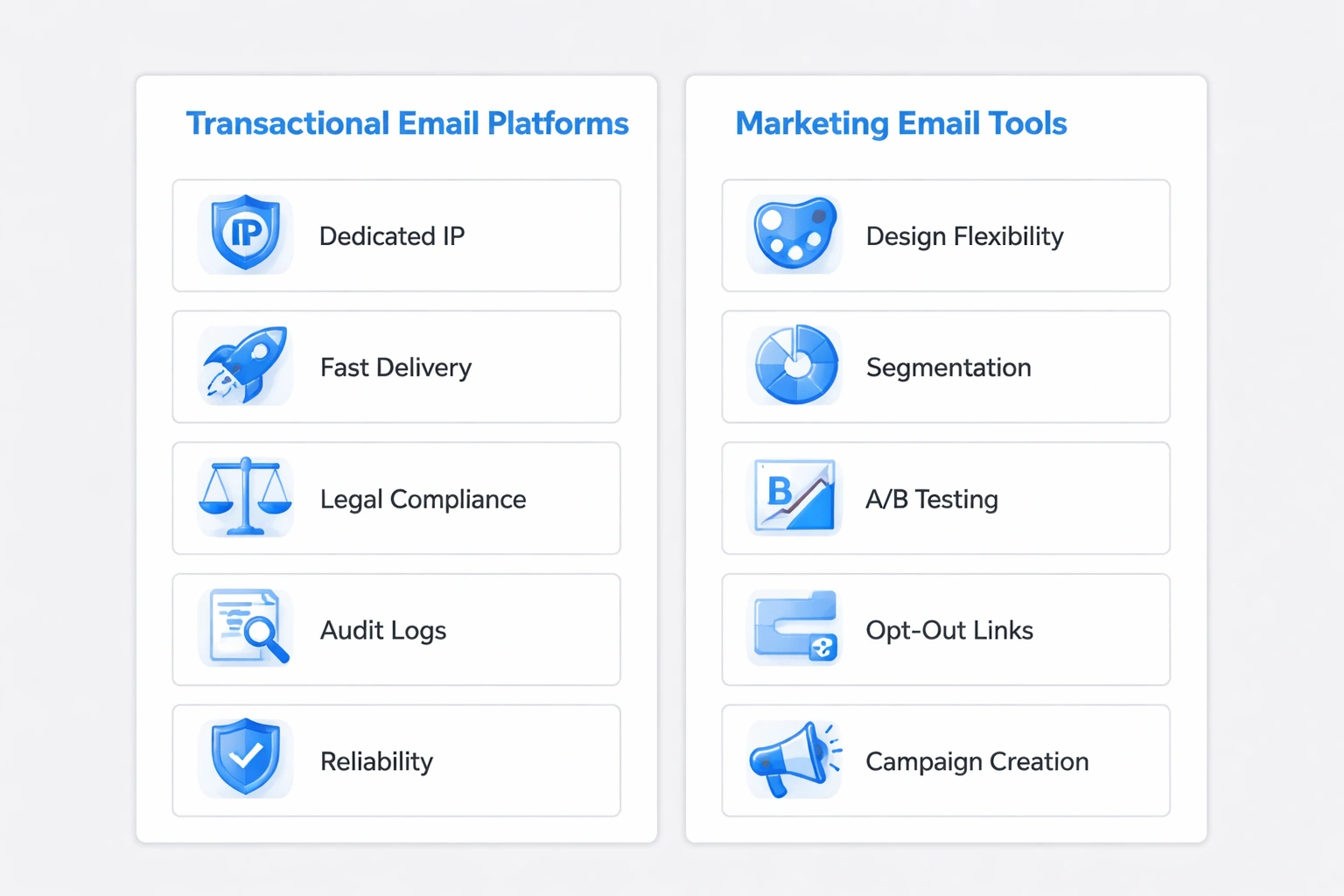
Speed and legal compliance. That's what transactional platforms care about. They route messages through dedicated IP addresses with established reputations so banks, retailers, and SaaS apps can send alerts within seconds. Design flexibility takes a backseat. Marketing platforms like Bokimo AI focus on campaign design and segmentation instead.
The law treats them differently too. Transactional emails don't need opt-out links when they're completing an agreed-upon transaction. Marketing emails do. Transactional platforms log every send for audits; marketing tools build A/B testing and conversion tracking.
Infrastructure separates them. Transactional platforms run hot standby servers and geographic redundancy because downtime during a payment confirmation isn't acceptable. They throttle sends based on recipient server capacity. Marketing tools batch messages for engagement windows.
Cost structures reflect this. Transactional services charge per message or API call roughly $0.0001 per email to start. Marketing platforms charge monthly based on list size. Many companies run both: Bokimo AI for marketing, a transactional provider for receipts.
Core features you actually need
API access. RESTful endpoints or SMTP relay. Modern platforms offer SDKs in Python, Node.js, Ruby, PHP with sub-50ms latency. Webhooks report delivery status back to your app.
Templates. Store HTML/CSS, merge with dynamic variables names, order numbers, tracking links. Version control prevents accidents during high-traffic periods. Preview tools show renders across email clients before you send.
Delivery infrastructure. This is what you're paying for. ISP relationships, domain authentication (SPF, DKIM, DMARC), blacklist monitoring, bounce handling. The platform suppresses invalid addresses automatically.
Analytics. Delivery rates, opens, clicks, bounces. Anomaly detection catches sudden drops. Exportable logs for compliance audits. Email deliverability best practices apply to both types.
The main platforms in 2026
SendGrid (Twilio) runs enterprise email. 99.97% uptime SLAs, 150 billion emails annually. $19.95/month for 50,000 sends, scaling to custom contracts. Good API, inbound parsing, single-sender verification for small campaigns.
Amazon SES wins on price $0.10 per 1,000 emails for EC2-hosted apps. Integrates with AWS Lambda and S3. But setup requires technical expertise: DNS records, manual IP warmup. No template editor. Built for developers who manage their own infrastructure.
Postmark does one thing: transactional email. They reject promotional content, which keeps deliverability above 98%. $15/month for 10,000 emails. Added broadcast features in 2025 for hybrid users.
Mailgun targets mid-market SaaS. Routing rules, European data residency, separate IP pools for different message types. Validation API checks syntax and mailbox existence. $35/month for 50,000 emails, 30-day log retention.
SparkPost uses predictive analytics to catch delivery issues before they hurt metrics. Adaptive Delivery adjusts speed based on engagement. Enterprise plans include dedicated support. Pricing requires sales contact. Mandrill refugees landed here.
When you actually need one
Over 100,000 monthly messages? You need specialized infrastructure. Generic SMTP servers will throttle you, especially during spikes like Black Friday. Dedicated platforms provision capacity ahead of demand.
Sub-minute delivery matters for password resets and two-factor codes. Marketing tools batch sends that latency kills time-sensitive messages. Transactional platforms prioritize queues.
Regulated industries need audit trails. Healthcare (HIPAA) and finance (GLBA) require immutable logs. Email marketing strategies skip these requirements.
Running multiple apps? E-commerce, CRM, support? Consolidate transactional email through one provider. One authentication setup, simpler monitoring.
Implementation
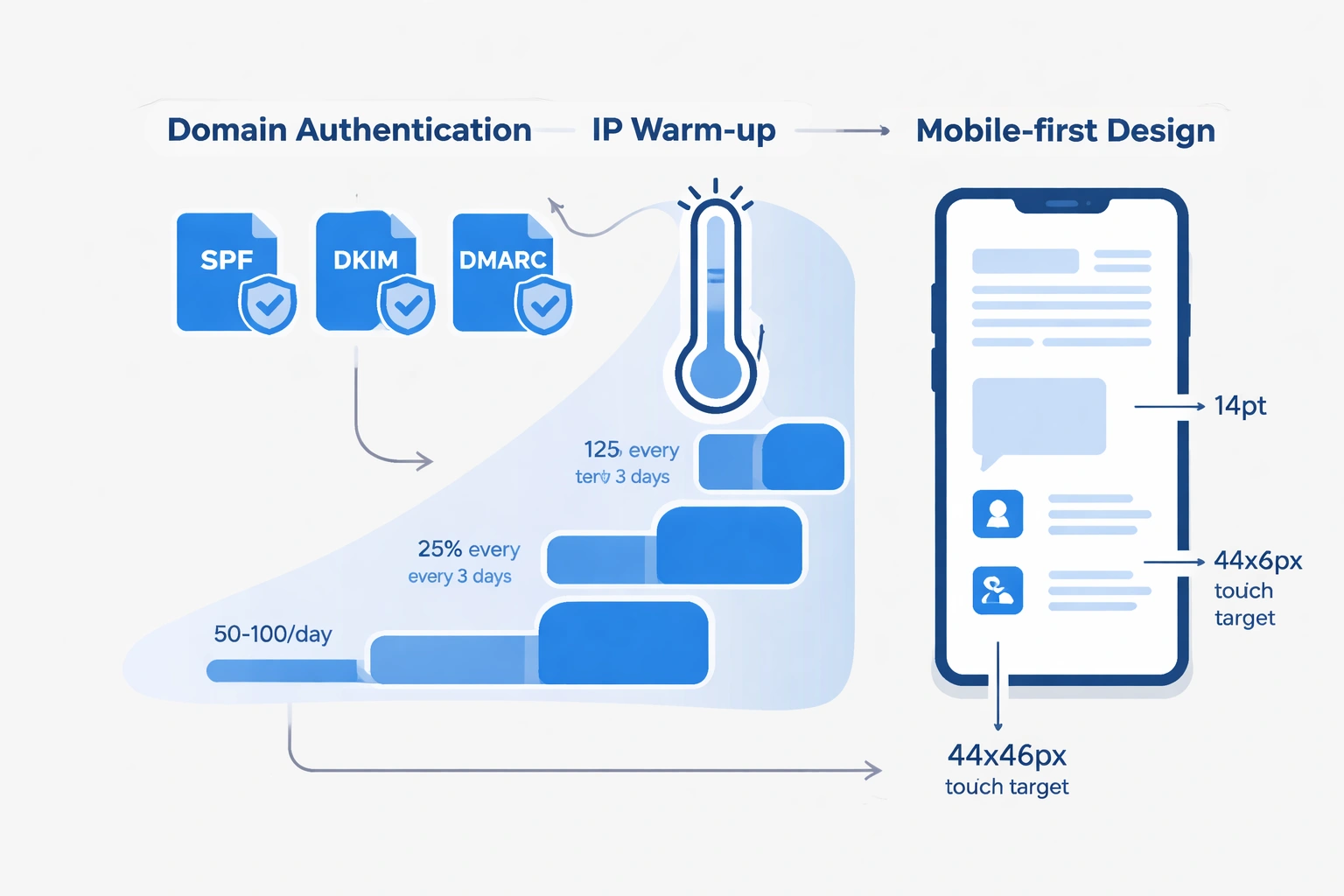
Authenticate your domain first. SPF records listing the platform's servers. DKIM keys published in DNS. DMARC policies to reject unauthenticated messages. This prevents spoofing and improves inbox placement.
Warm up IPs slowly. Start with 50-100 emails daily to engaged recipients. Increase 25% every three days while watching bounce rates. Dedicated IPs need four to six weeks; shared pools handle this automatically.
Design for mobile. 60% of transactional opens happen on phones. Single-column layouts, 14px+ fonts, 44x44px touch targets. Inline CSS for Outlook compatibility. Test through Litmus or Email on Acid.
Set up webhooks. Delivery confirmations, bounces, spam complaints in real time. Suppress dead addresses automatically. Email automation sequences use these events.
Handle errors gracefully. Exponential backoff on rate limits retry after 1 second, then 2, 4, 8. Queue locally during outages. Log everything with context.
What it costs
Volume tiers sit at 10K, 50K, 100K, 500K monthly sends. SendGrid: $19.95 for 50K ($0.0004 each), $89.95 for 100K ($0.0009 each) more expensive at scale. Amazon SES: flat $0.0001. Calculate at peak usage, not averages.
Watch for hidden fees. Dedicated IPs: $30-90/month. Phone support: $200-500. EU data residency: 15-25% extra. Overage penalties can triple per-message rates.
Free tiers work for testing. SendGrid's 100 daily emails, Mailgun's 5,000 monthly for three months, AWS SES's 62,000 with EC2. Upgrade at 80% capacity.
Hybrid strategies save money. Bokimo AI charges by list size, not volume. Daily receipts plus monthly newsletters? Split the work.
E-commerce integration
Shopify: Apps like SendGrid's sync order data automatically. Postmark's plugin replaces default notifications. No coding, but costs stack Shopify Plus plus platform fees.
WooCommerce: Mailgun's plugin adds SMTP relay. Advanced: hook into woocommerce_order_status_completed to call APIs directly. Bypasses WordPress's unreliable mail functions.
Headless: Next.js storefronts call endpoints from serverless functions after Stripe webhooks. Dynamic templates merge Contentful data with SendGrid's API. Sub-second confirmations. E-commerce solutions gain from this architecture.
Subscriptions: Layer customer.io or Vero on top of transactional platforms for lifecycle messaging. Transactional handles invoices; SaaS email strategies need both.
Security and compliance
Rotate API keys quarterly. Store credentials in environment variables or secret managers not code repos. Implement IP whitelisting.
GDPR requires European data stay in EU borders. Mailgun and SendGrid have data centers in Ireland and Germany. Amazon SES has EU-West regions. Check contracts for processing locations.
Content filtering protects reputation. Platforms scan attachments for malware, validate URLs against phishing databases. Occasionally blocks legitimate messages worth knowing.
Including promotional content in transactional emails converts them to marketing under regulations, requiring opt-outs. Transactional versus marketing compliance needs attention. Audit templates quarterly.
Monitoring
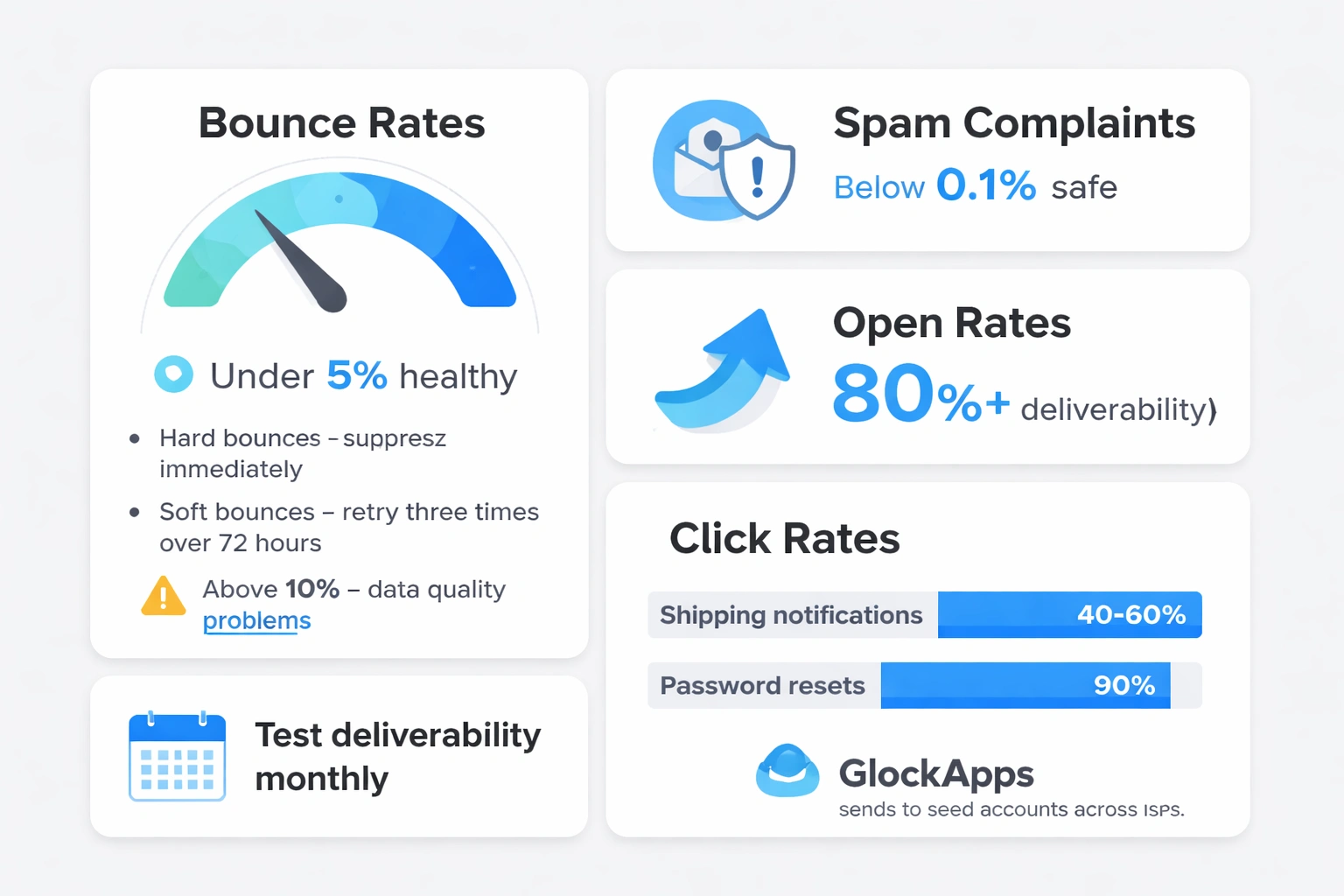
Bounce rates under 5% are healthy. Hard bounces suppress immediately. Soft bounces retry three times over 72 hours. Above 10% means data quality problems.
Spam complaints below 0.1%. Higher rates damage sender scores. Solution: clearer sender names, reference the action in subject lines ("Your Order #12345" not "Order Update").
Transactional open rates (80%+) measure deliverability, not content. Click rates vary shipping notifications 40-60%, password resets 90%+. Watch trends.
Test deliverability monthly. GlockApps sends to seed accounts across ISPs. Email deliverability optimization requires ongoing attention.
Scaling
Multi-region deployment reduces latency. Route US customers through us-east-1, Europeans through eu-west-1. Provides failover if one region fails.
Rate limiting prevents cascading failures. Queue 1,000 simultaneous requests. Exponential backoff with jitter prevents thundering herd. RabbitMQ or AWS SQS buffers requests.
Microservices architecture isolates email. Dedicated notification service handles templates and retries. Other apps publish events. Checkouts work even when confirmations lag.
Hybrid approaches
Tag transactional emails with metadata for isolated tracking. Bokimo AI's features support both message types. Works for under 50K monthly sends.
Route transactional through Postmark or SES, campaigns through Bokimo AI. Keeps reputations separate. Marketing experiments won't affect critical notifications.
Unified dashboards (Datadog, custom scripts) aggregate metrics. Compare open rates. Track total costs.
Workflow automation bridges both. Zapier triggers Bokimo AI campaigns from transactional webhooks.
Choosing
Startups: documentation quality, SDK libraries, generous free tiers. Plan for migration costs later.
Enterprise: SLAs, SOC 2 Type II, HIPAA, GDPR. Negotiable contracts. Six-figure commitments.
Agencies: subaccounts with isolated credentials. Mailgun and SparkPost white-label. Reseller discounts.
Technical teams: API sophistication. Robust webhooks, detailed error codes, staging environments. Integration capabilities matter long-term.
What's next
AI-powered send-time optimization will predict when individuals check email. Non-urgent messages get delayed; critical sends stay immediate.
AMP for Email expands beyond static content. Recipients complete surveys, update preferences within emails. Google and Yahoo support it now.
AI email generation automates template creation. Describe the message, get responsive HTML. Bokimo AI applies Claude Opus for this.
Getting started
Sign up for SendGrid, Postmark, and Mailgun simultaneously. Send tests to Gmail, Outlook, Apple Mail. Compare delivery speed and spam placement. Most trials: 30 days, 1,000-10,000 free sends.
Migration: export HTML, import to new provider. Check variable syntax. Test edge cases. Two to four hours per template.
DNS changes: collect records, schedule during low traffic. Propagation: four to 48 hours. Monitor for 72 hours. Keep old credentials for failover.
Start with essentials receipts, password resets. Add lifecycle emails later. Eventually split: Bokimo AI for marketing, transactional provider for operations.
The right choice depends on your volume, technical capacity, and growth. Start small, test thoroughly, scale when the free tier starts hurting.
Published with LeafPad